A from-scratch
x86_64 kernel.
Boots into ring 3.
Open Cube OS 3.0.0-WP06c (development preview) boots through its own bootloader and kernel (L0), then hands the machine to the default ring-3 application — the ush user shell with 285 commands riding the SYS_L1SVC service surface. L0 is a pure service kernel: no shell, no commands, no TUI. Not a Linux fork: 128,890 lines of original code, Apache 2.0.
[oc] Open Cube OS 3.0.0-WP06c kmain entered
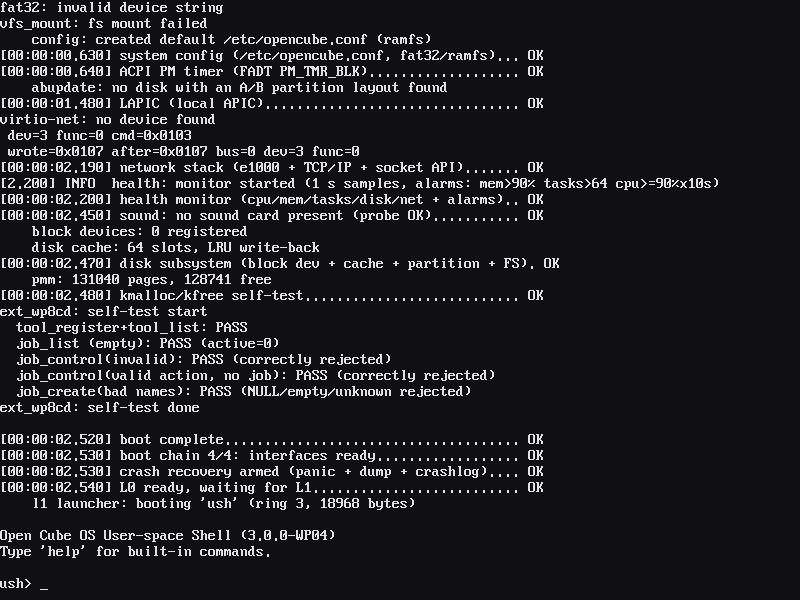
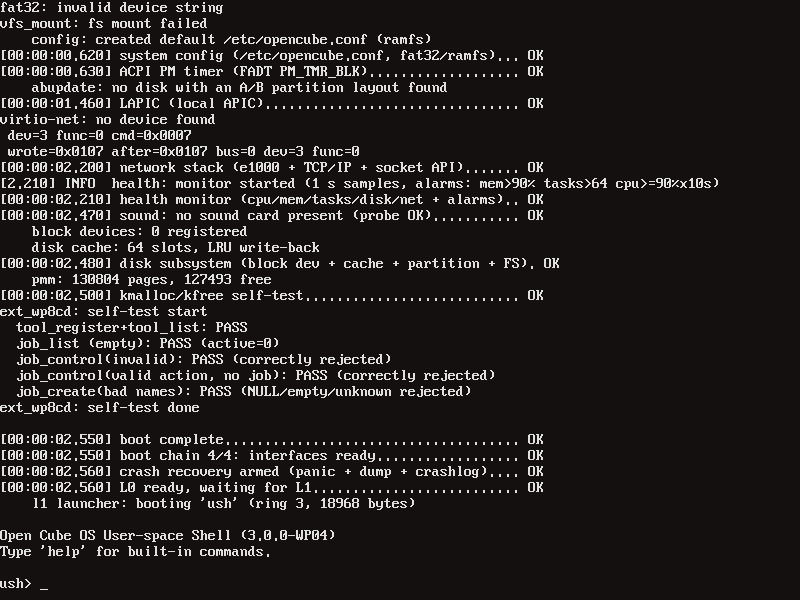
[00:00:02.550] boot complete..................... OK
[00:00:02.560] L0 ready, waiting for L1.......... OK
l1 launcher: booting 'ush' (ring 3, 18968 bytes)

Open Cube OS User-space Shell (ush)
ush> █
Features
A real kernel, not a demo: preemptive scheduling, four-level paging, ring-3 processes, a VFS over four filesystems, a full TCP/IP stack with TLS and SSH (client and server), 16 driver families, crash dumps, hardware watchdogs, and OTA A/B updates.
OCBL - the in-tree bootloader
One ISO boots both firmware paths through OCBL, the self-written bootloader (16→32→64-bit long mode, dynamic disk scan) - no GRUB anywhere in the 3.0.0 chain.
PMM / VMM / heap
Bitmap physical manager over the multiboot2 map, 4-level paging, kmalloc with coalescing and stack/heap growth by page fault.
Preemptive scheduler
Priority + round-robin over TCBs, 100 Hz tick, soft-timer wheel, IST-separated exception stacks, live 3/3 trap self-test on every boot.
User programs
ELF loader, 54 syscalls, fork/exec/pipes/signals/select/mmap, an in-tree shared-object loader with dlsym and PIE relocations - and the SYS_L1SVC + SYS_NETCMD service bridges.
TCP/IP + TLS + SSH
Seven NIC driver families, congestion-controlled TCP, sockets, firewall, an HTTPS client with X.509 verification, and a real sshd in-guest.
NVMe to FAT32
AHCI/ATA-DMA/NVMe/virtio/USB-MSC/SD/SCSI block devices; FAT32 with LFN, exFAT, ext4, ramfs; a persistent /etc volume.
Four USB stacks
UHCI, OHCI, EHCI and xHCI host controllers with MSC, HID, serial and audio classes - hotplug included.
Crash + watchdogs
Register dumps to serial and crashlogs to /etc, Intel TCO and ACPI WDAT hardware watchdogs, policy watchdog slots, health alarms and JSON export.
One shell, all ring 3
ush is the only shell: 274 registry apps (one command = one app = one folder under src/L1/) plus 11 built-ins with pipes, jobs, wildcards, aliases and an editor. The 2.x L0 recovery shell was removed in WP-03 - L0 has no shell at all.
Terminal UI - an L1 world
Desktop, taskbar, menus, forms, editor and system apps ride the L1SVC tui service from ring 3 - plus a Chinese console layer with a pinyin IME, all under src/L1/.
A/B updates
Manifest-driven OTA with SHA256 + signature verification, staged install onto the inactive slot, automatic rollback.
20 services / 190 ops
The ring-3 surface is the contract: 20 SYS_L1SVC service categories with 190 numbered ops, every operational command class behind one syscall. The v1→v2 mapping table ships in INTERFACES.md.
Quick start
From download to a ush> prompt in about a minute. Any machine with QEMU works; real hardware boots the same ISO from USB.
Boot the ISO in QEMU
One command - the ISO is self-contained, 512 MiB of RAM is comfortable.
Watch it come up
One OK line per subsystem: the OCBL handoff, long mode, framebuffer, IDT, PIT, PMM, drivers, VFS, network - then L0 ready, waiting for L1.
Drive the machine
Bring up networking, pull a page, inspect the system - every command is a ring-3 app served from the registry.
Go deeper
The documentation center has the user manual, the command reference, the developer handbook, the L1 extension guide and the architecture deep-dives.
It really runs
Captured from the 3.0.0-WP06c release ISO in QEMU - the BIOS and the UEFI boot path, through OCBL to the ring-3 ush prompt.
The two-layer idea
“Everything is extensible” is the whole design: L0 is a pure service kernel and nothing more; everything users actually see - the shell, the TUI desktop, the editor, the IME - is an L1 program riding the surface.
OCOS - the service kernel
Kernel + drivers + root services + the numbered L1SVC interface. Boots, serves, recovers - and stops there: no shell, no commands, no TUI, no IME in L0 (the 2.x recovery shell was removed in WP-03). This repository.
The ring-3 world
275 programs under src/L1/: ush, the TUI desktop, the editor, the Chinese console + IME and one command per app - every operational command class runs behind the 20-service SYS_L1SVC surface.
Cube OS = L0 + L1
The roadmap: a complete, daily-usable system assembled from the kernel below and the extension ecosystem above.
See the whole picture
OCBL boot flow, every L0 subsystem, the L1 program world and the 20-service L1SVC surface, each on its own page.